The Myth of Low Acid Tomatoes
So many people are passionate for a delicious, home-grown tomato. In addition to being one of the most sought-after products at summer growers’ markets, tomatoes are also very healthy. They contain plenty of vitamin A and C, as well as folic acid, not to mention powerful antioxidants such as lycopene, beta-carotene and lutein. Sadly, there is a subset of people whose digestive systems cannot tolerate tomatoes due mainly to their acidity.
As a result, people ask me all the time, on their doctors’ recommendations, if I offer any “low acid” tomatoes. My response is no because the scientific data does not back up the low acid claim. I first learned of the low acid tomato myth in a great book called “Epic Tomatoes,” by one of my go-to heirloom tomato resources, Craig LeHoullier. In his book, Craig refers to research showing that the acid levels across many different varieties of tomatoes does not vary enough for any one variety to be considered low acid. Out of curiosity, I asked Craig if he could provide the studies behind the truth about tomato acidity.
I received two U.S. Department of Agriculture studies published in the monthly HortScience Journal, one from June of 1977 and another from April of 1978. The first study screened 58 cultivars of tomatoes, including red, yellow, and orange, hybrids and heirlooms, old and new varieties. Supplemental data was gathered and analyzed from studies for over 350 cultivars from 23 state agricultural experiment stations and multiple USDA laboratories. The motivation behind these studies was to test whether acid levels in tomatoes were adequate to prevent botulism in home canning. The results are interesting for the “low acid for health reasons” question as well.
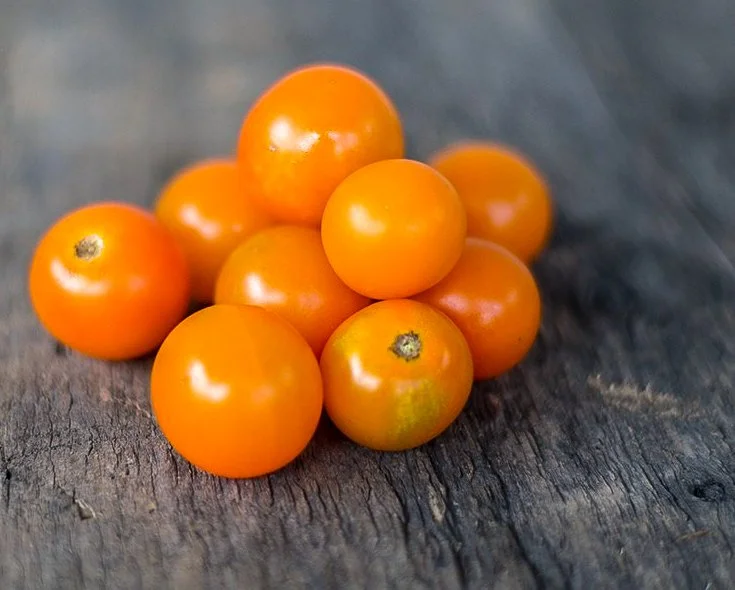
Sungold
The public has been told repeatedly that the lighter colored yellow and orange tomatoes, as well as the small-fruited and newer varieties, are lower in acid than traditional, red tomatoes. The data showed that the lighter colored and smaller tomato varieties were actually higher in acid than standard red tomato varieties. The mean pH among tested varieties varied within a narrow band, between 4.14 (most acidic) and 4.68 (least acidic). There were higher pH outliers, but these anomalies were most likely due to growing location and those tomatoes being over ripe. It is likely that yellow and orange tomato varieties were assumed to be lower in acid due to a higher sugar content (these types tend to be sweeter than traditional red tomatoes), which masks acidity.
In conclusion, all tomatoes have roughly the same acidity. There really are no low acid tomatoes. However, I do add a teaspoon of citric acid to my quart jars when canning tomatoes for assurance.